01.The concept
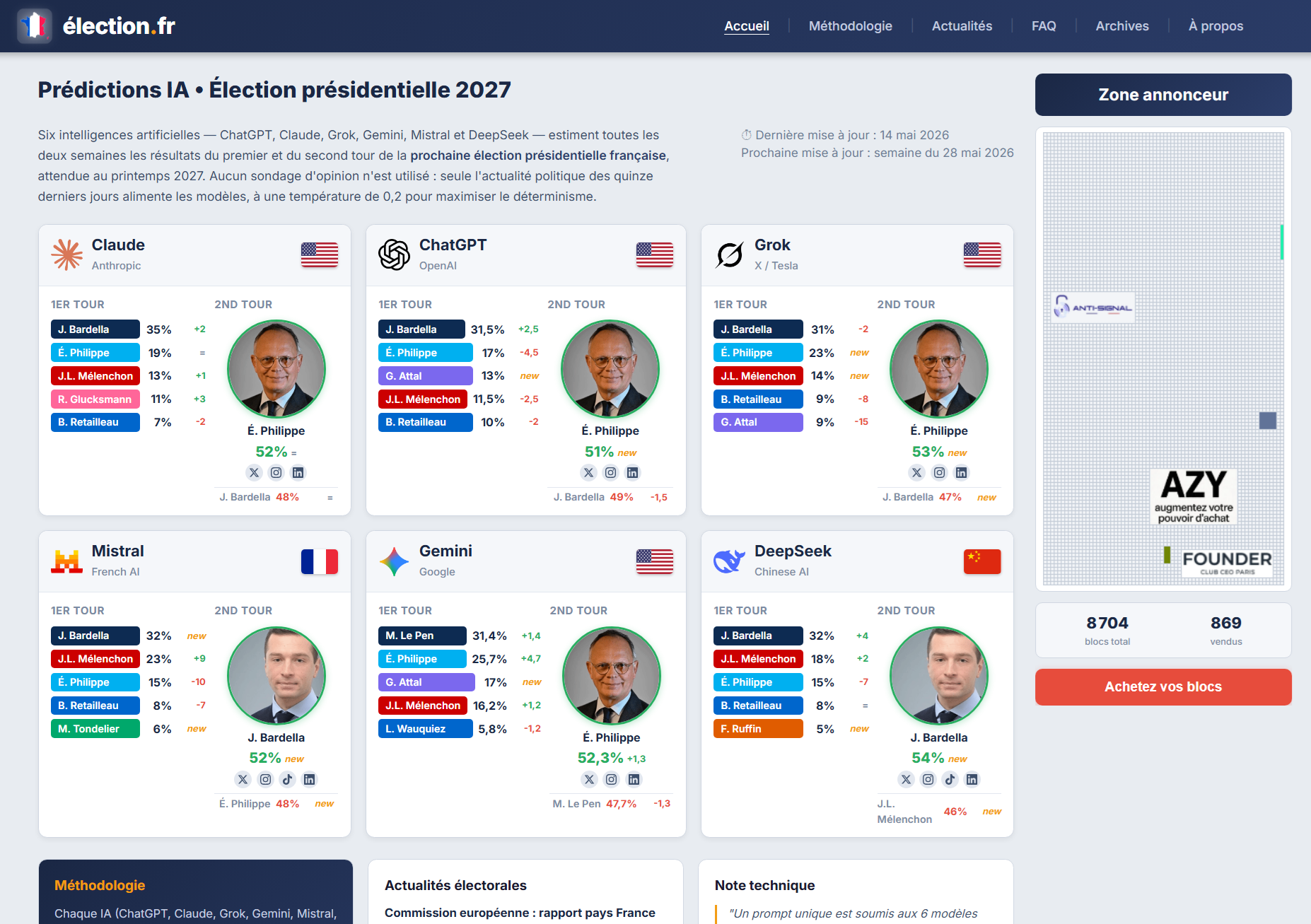
élection.fr is an experimental platform launched by VRDCI in March 2026: every two weeks it queries six leading generative AIs — ChatGPT (OpenAI), Claude (Anthropic), Grok (X/xAI), Gemini (Google), Mistral and DeepSeek — on the likely results of both rounds of the next French presidential election, expected in spring 2027.
No conventional opinion poll is used. The bet is radical: compare, week after week, the political news analysis produced by the six most widely used models in the world, and watch how they converge, or diverge, over time.
02.The method, 6 AIs, 0 polls
Every fifteen days, the same prompt is submitted to the six models. Each AI produces an independent estimate for the first round (5 main candidates) and for the second (most likely run-off). Results are dated, archived and compared with their previous versions.
03.Technical protocol
The protocol comes down to four simple rules, and that is what makes it reproducible:
- A single news window: 15 days
No model is fed a long history. Only the political news of the last two weeks goes into the prompt, in order to measure each AI's sensitivity to recent signals.
- Temperature fixed at 0.2
A low temperature maximises determinism: given an identical prompt, the same AI should produce roughly the same answer. That is what makes the fortnightly comparison meaningful.
- Strictly identical prompt for all 6 models
No fine-tuning, no per-AI custom prompt. The only variable explaining the gaps is the model itself.
- Public, timestamped archiving
Every forecast is frozen, dated and compared with its previous versions. You can see who predicts what, and who changes their mind.
04.The 28 April 2026 barometer
To illustrate the mechanics, here is the consolidation of the 6 AIs as of 28 April 2026 (next update: week of 12 May 2026).
First round, average of the 6 models
Second round, most likely run-off
| Candidate | Estimate | Trend |
|---|---|---|
| É. Philippe | 52% | = stable |
| J. Bardella | 48% | = stable |
Source: élection.fr, average of the 6 AIs, data archived on 28/04/2026.
05.Why it is interesting
Watching an AI change its mind
The archive makes it possible to see over time how each model reacts to an event: a resignation, a candidacy announcement, a televised debate.
Comparing 6 AIs on the same ground
With a strictly identical prompt, the gaps between models say something about their biases, their training sources and their sensitivity to the news.
Exploring new ground
This is not a poll, it is an algorithmic reading of the debate. One more lens for observing the French political ecosystem on the road to 2027.
What it is not: élection.fr is not an opinion poll and does not claim to replace Ifop, Ipsos, Elabe or Harris. It is an observation lab for AIs facing a live political subject. The forecasts shown are the output of generative models and should be read as such.
06.What comes next
As the campaign takes shape, upcoming updates will add a “daily news” module measuring the impact of each event on the predictions, the arrival of new candidates (G. Attal appears at 24% in some predictions), and an extension to the legislative elections that follow.
See the live barometer
Updated every two weeks, open access, no sign-up.
CEO & founder, VRDCI